Total Pageviews

Showing posts with label Design. Show all posts

Tuesday, June 7, 2011

Lariat Seat Loops - James Garvey

James Garvey is an artist and a blacksmith. He created fourteen sculptural lariat seat loops for the 33rd Street station of the New York Subway system. Inspired by a lasso demonstration in a Will Rogers film clip, he created seat rests and hand holds that invite one to touch the thick ropes of bronze. Garvey sees labor intensive, one of a kind products as referencing a traditional work ethic recognized and practiced by many cultures throughout the world.


Sunday, May 1, 2011

Design - Maezm
Cho Eun Whan and Shin Tai Ho are the founding members of the Korean Design Team Maezm. The Table Dish Cover in these photographs acts like a flexible, portable picnic blanket - you can spread it out anywhere, fill up each dish with food, and wash it when you're done. Fun! Made from a special, food-safe, injection-molded silicon it can be folded, rolled or crushed making dining and clean-up a simple process! 


Friday, April 1, 2011

The Chair - Point of departure 


Wikipedia - A chair is a stable, raised surface used to sit on, commonly for use by one person. Chairs are most often supported by four legs; however, a chair can have three legs (in a triangle shape) or could have a different shape depending on the criteria of the chair specifications. A chair without a back or arm rests is a stool, or when raised up, a bar stool. A chair with arms is an armchair and with folding action and inclining footrest, a recliner. A permanently fixed chair in a train or theater is a seat or airline seat; when riding, it is a saddle and bicycle saddle, and for an automobile, a car seat or infant seat. With wheels it is a wheelchair and when hung from above, a swing. A chair for more than one person is a couch, sofa, settee or "loveseat" or a bench
Considering this very thorough definition, one would think that the chair is well understood and that there is little territory left to explore. Surprisingly, many artists and designers enjoy the challenge of rethinking the “chair.” Here are some interesting examples of re-visioning this object.

Jordi Canudas (Barcelona, Spain) strives to achieve what he refers to as “action” in his work. He uses malleable materials; rubber bands, stretchy fabric, foam, and metal springs. He’s influenced by what is pliable, the melting process, solid to liquid, rigid to soft, order to chaos. I might add that at least in this piece, he’s also been inspired by nature, particularly the bat.


This loveseat/chair designed by Lila Jang gives new meaning to the phrase “climbing the walls.” She created this installation piece based on an 18th century French Louis XVI style armchair. Most likely she was also inspired by the frustrations caused by living in a small space and other pressures/limitations of urban life. She refers to it as “Small Space Sofa,” and “Tomorrow Sofa.”

Dutch designer Sophie de Vocht created this hybrid chair/rug/lounge. It is made of 1000 feet of yarn pulled through a metal wire mesh. This piece combines our love for sitting on the floor and appreciation for comfort with the youthful whimsy of a child’s homemade potholder. 


Daniel Spoerri is a Swiss artist and writer born in Romania. He has been called “the central figure of European post-war art” He calls himself the “paster of found situations” and is known for capturing a group of objects in a type of assemblage, often the pieces are the remains of a meal. His interest lies in mapping what is on his table, sofa or chair at a particular moment, making each object important, describing and recognizing the significance of what each evokes.


Monday, March 7, 2011

Design

To repurpose is to use an item or substance for something other than it’s intended use. In this article, we celebrate four designers unique approach to recycling.

Ramon Coronado's project 'mercado negro' means “black market' in Spanish. The plan took 12-weeks requiring Coronado to dismantle and reassemble shopping carts (abandoned on the streets or thrown into the LA River) into his unique form of art. He built a chair, table and lamp. When photographed on the “beach” of the LA River, Coronado makes his comment on the lack of parks and functional recreational spaces within the city of Los Angeles.
http://www.ramoncoronado.info/


Joy van Erven (Dutch) and Finn Ahlgren (Swedish) met in an Israel. With a joint interest in the unconventional, they started a the design studio named Godspeed. Each piece they make is constructed from scraps in the space of one hour. The speed with which they create an object results in their signature, an honest, straight forward design aesthetic which captures the essence of whatever they choose to create.


Designer Andrew Rumpler built these chairs out of salvaged piano keys.
He calls them “Tatum’s Lounge” after the 1940s stride pianist. It’s a play on words derived not only from the “lounge” style chair, but also the Harlem venues Tatum frequented as a pianist. The ivories are white, while also being very “green.”


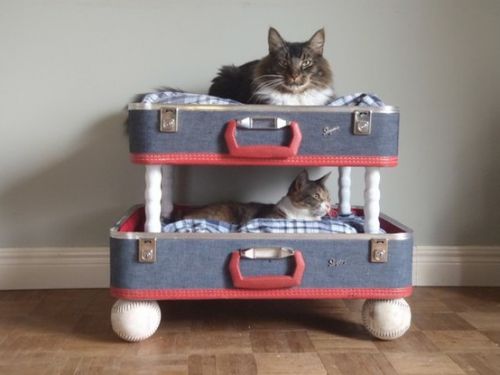
Suitcase Pet Beds - Although this idea has been around for a while, it recently has become the latest in DIY home projects. Take the challenge yourself, what can I reuse?

Wednesday, February 2, 2011

Space, Comfort and Protection


Ernsto Neto is a well known Brazilian sculptor interested in art as it relates to the living organism, he creates installations some refer to as organic architecture. His materials are thin soft stretchable fabrics sometimes stuffed with scented spices. The pieces are meant to be smelled and touched by the viewer, making one an active, intimate participant in the work. Ernesto describes his installations as “a place of sensations, a place of exchange and continuity between people, a skin of existence and relationships.”


Joo Youn Paek is a student at NYU and an object maker. She is also interested in personal space and particularly human behavior in response to the environment. Her pillow wig allows one to sleep virtually anywhere at any time; the subway, airplane, library classroom or laundromat. She intends the work to be humorous and practical. She intends to combine art and activism while exploring the world around her.


Hizamakura in Janpanese literally means “knee-pillow.” The object is shaped like a woman’s lap. It is made out of a skin-like material and is wearing a skirt and underwear. This product is based on a Japanese tradition, young children lay their heads on their mother’s lap while having their ears cleaned. 耳掃除 (mimi souji) or “ear-cleaning.”  Apparently, some Japanese men still desire the feeling of lying with one’s head on the lap of a mother or girlfriend as they age. Although the Hizamakura is not intended as an object of art, it does address personal space, the desire for intimacy,comfort and sensation of touch.